It is early May.
The dining room table is covered in flashcards, the air is thick with tension and your teenager is alternating between last-minute revision, frantic studying and staring blankly at their phone.
Welcome to the GCSE pressure cooker.
Unlike the assessments they took in primary school, Key Stage 4 (KS4) exams represent the first time your child's academic results carry significant real-world weight. These grades determine their Post-16 Pathways (whether they move on to A-Levels, T-Levels, or Apprenticeships) and often dictate which sixth form or college will accept them.
The stakes feel incredibly high, and teenagers are acutely aware of it. As the exam dates loom closer, the temptation for KS4 students is to cram—sacrificing sleep to read textbooks until 2:00 am. However, educational psychology tells us this is the exact recipe for academic burnout.
If your home has become a battleground of slammed doors, tears, and frustration, it is time to change the strategy. This guide will help you identify the signs of teenage burnout, introduce science-backed last-minute GCSE revision hacks, and provide practical tools to manage your child's exam anxiety.
🔥 1. Spotting the Signs of GCSE Burnout
Burnout is more than just feeling tired; it is a state of physical, emotional and mental exhaustion caused by prolonged stress. For example; relentless study sessions, dealing with exam stress, time management and juggling revision plans with family members and personal commitments.
Young people, especially teenagers, are particularly susceptible to burnout because their brains are still developing the executive functioning skills required to manage large, long-term projects (like a multi-subject exam timetable). For that reason, it’s not uncommon to find KS4 students struggling to manage exam stress, revision sessions and general life!
The Statistic for Your Graph: The Anxiety Gap
To understand what your teenager is going through, we just need to look at the data; teenage exam stress and mental health is real!
A recent report by Education Today revealed the staggering impact of exam season on KS4 students:
- 85% of teenagers report experiencing high levels of anxiety related to their exams.
- Only 15% report feeling their exam stress is at a manageable, healthy level (aka no anxiety)
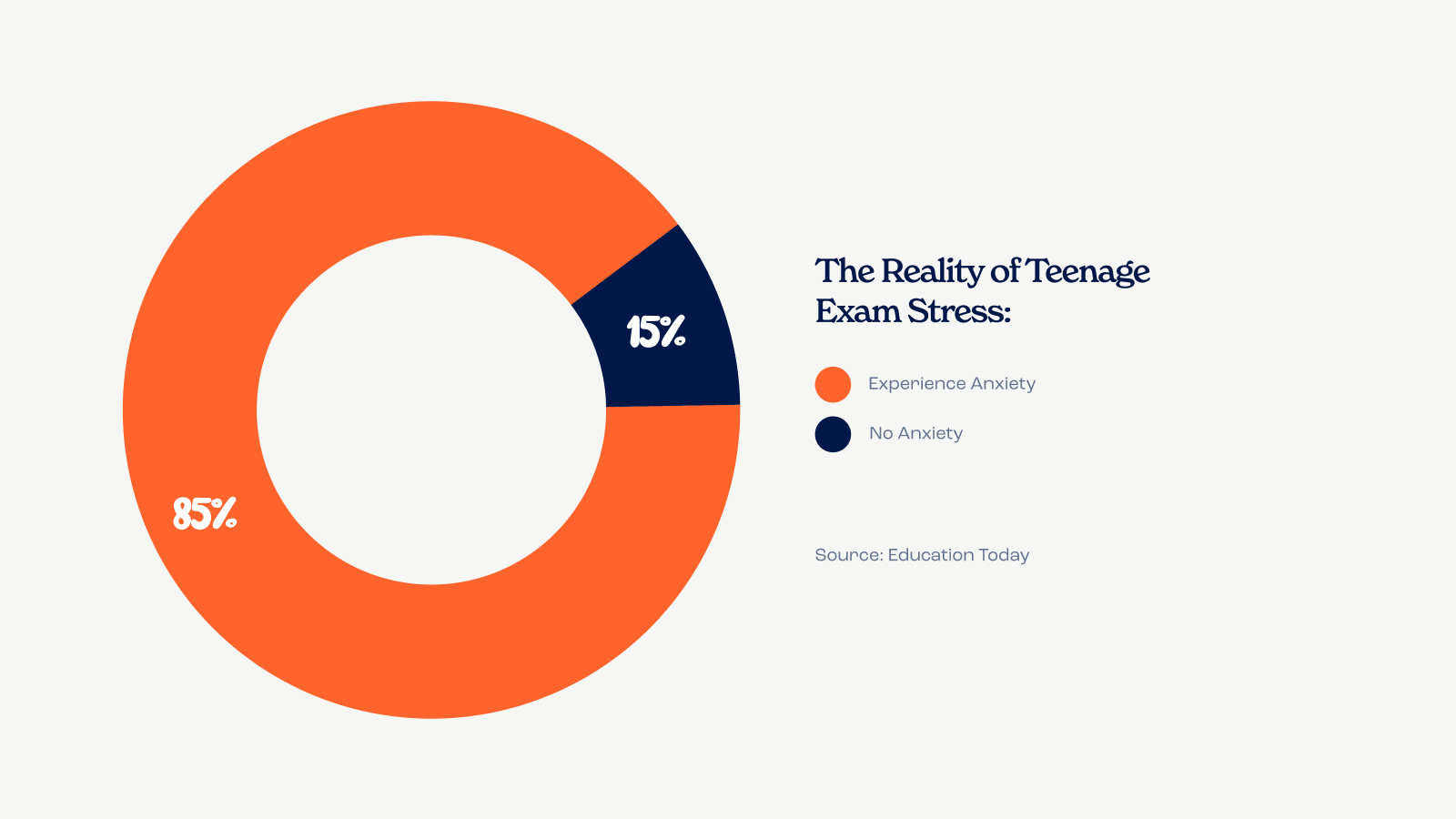
What’s more, of those 85%, only 14% actually seek support!
Before you can help them revise, you need to know if they are already running on empty. Look out for these core signs of burnout:
- Physical: Frequent tension headaches, disrupted sleep patterns, or a sudden change in eating habits.
- Emotional: Extreme irritability, crying over minor inconveniences, or expressing apathy and hopelessness ("I'm going to fail maths anyway, so what's the point in trying?").
- Behavioural: Procrastination, staring at a laptop screen for hours without typing anything, or a sudden drop in scores on their practice papers.
If you spot these signs, the first step is always to enforce a break. A rested teenage brain will retain more information in 20 minutes than a burnt-out brain will in three hours of forced reading.
❌ 2. The End of "Junk" Revision Methods: Why Reading Doesn't Work
If the exams are just weeks away, your teenager needs to stop engaging in passive revision.
Many students think they are studying when they are actually just "junk revising." This includes reading over old notes, highlighting textbooks in neon colors, or copying out pages from a revision guide. These methods feel productive, but they do not force the brain to actually retrieve information.
According to cognitive scientists and resources like , students must shift to Active Recall. Active recall forces the brain to pull information from memory, which is exactly what they will have to do in the exam hall.
💡 3. Last-Minute GCSE Revision Hacks That Actually Work
If time is running out, you need maximum efficiency. Here are four highly effective, science-backed revision tips to maximise their remaining study leave.
Hack 1: The "Blurting" Method (The Ultimate Brain Dump)
This is the most effective way to expose what a student doesn't know.
- The Method: Give your teenager a blank piece of paper and a broad GCSE topic (e.g., "The Causes of WW1" or "Cell Biology"). Set a timer for 5 minutes and tell them to write down or draw everything they can remember. Once the timer rings, they open their textbook and use a different colored pen to add what they missed.
- Why it works: The second color immediately highlights their knowledge gaps. Instead of re-reading the whole chapter, they now know exactly which specific facts they need to focus on.
Hack 2: The Pomodoro Technique
The teenage brain is not designed to focus intensely for 4 hours straight. The Pomodoro Technique breaks work into manageable intervals, curing procrastination.
- The Method: Set a timer for 25 minutes of highly focused, phone-free work, followed by a strict 5-minute break. After four 25-minute "Pomodoros," take a longer 20-30 minute break.
- Why it works: It creates a sense of urgency while guaranteeing a reward (the break). During the 5-minute break, encourage them to step away from the desk—get a drink, stretch, or step outside. Regular breaks also create discipline and routine.
Hack 3: Interleaving Past Papers
Doing past papers from their relevant exam board is vital, but how they do them matters.
- The Method: Instead of spending a whole day just doing GCSE Maths papers, mix the subjects up (interleaving). Do 45 minutes of a Maths paper, take a break, then do 45 minutes of a Geography paper.
- Why it works: Varying revision topics prevents the brain from going onto "autopilot" and keeps cognitive engagement high. Furthermore, experiencing different types of questions keeps the brain stimulated and maximises study time.
Hack 4: The Feynman Technique
Named after the Nobel Prize-winning physicist Richard Feynman, this technique is brilliant for complex GCSE Science or Geography topics.
- The Method: Ask your teenager to teach the concept to you, a younger sibling, or even the family dog, using the simplest language possible.
- Why it works: You cannot teach what you do not understand. If they stumble, rely on complex jargon, or get frustrated, it exposes the exact point where their understanding breaks down.
👊 4. Conquering Exam Panic
Sometimes, a student knows the material perfectly, but their mind goes completely blank the moment they step into an exam hall and turn over the exam paper. This is the physiological "fight or flight" response kicking in.
To help them manage this, and avoid feeling overwhelmed, teach them these coping mechanisms before the first exam:
- Box Breathing: This technique is used by athletes to lower heart rates and stop panic attacks. Inhale for 4 seconds, hold for 4 seconds, exhale for 4 seconds, hold for 4 seconds. Repeat four times. It physically forces the nervous system to calm down.
- The "Skip and Return" Rule: Give them permission to skip a question that causes panic. Tell them, "If you read a question and your heart races, put a small star next to it and immediately move to the next one. Come back to it when you have some easy marks under your belt."
- Normalise the Nerves: Let them know that feeling nervous is completely normal. Reframing "anxiety" as "adrenaline" can help them see it as a natural energy source they can use to focus, rather than a threat.
✅ 5. The Parent Playbook: How to Support Without Nagging
Parenting a KS4 student during May is a delicate balancing act. If you ask them if they are revising, you are "nagging." If you leave them alone, you worry they are failing.
Here is how to be their Chief Support Officer:
- Manage the Environment, Not the Student: Instead of micromanaging their timetable, focus on creating a frictionless environment. Keep the house as peaceful as possible. Defer arguments about messy bedrooms until July. Your primary job right now is to keep the atmosphere calm.
- Fuel for the Brain: Nutrition plays a massive role in cognitive function. Teenagers left to their own devices will often reach for energy drinks and sugary snacks, which cause massive energy crashes. Swap these out for slow-release energy foods. Bring them unsolicited snacks while they work: whole-wheat toast, bananas, nuts, and plenty of water.
- Guard Their Sleep: According to the NHS, teenagers need 8 to 10 hours of sleep for optimal brain function. Late-night cramming actually degrades memory retention. Agree on a hard cut-off time for revision (e.g., 9:00 pm), after which all textbooks are closed and screens are turned off to allow the brain to wind down.
- Praise the Effort, Not the Expected Grade Never tie their self-worth to a GCSE grade. Say things like, "I am so proud of how hard you worked on that chemistry revision today," rather than "I know you're going to get a Grade 8." This removes the crushing weight of expectation.
Perspective is Everything
When you are in the thick of GCSE season, a single exam can feel like a life-or-death scenario to a teenager. The most important thing you can do as a parent is to maintain perspective.
Remind them constantly that their GCSE results do not define their future, their intelligence, or their worth as a person. They are simply a snapshot of what they knew on one particular day. If things don't go to plan, there are always alternative routes, resits, and different educational pathways available.
If they have done their best, that is always enough.
Does Your Teenager Need Targeted Support?
Sometimes, the stress of GCSEs stems from fundamental gaps in a student's understanding that simply cannot be fixed with a week of cramming alone. If your teenager is constantly battling anxiety because they feel behind in core subjects, professional tuition can change their entire trajectory.
At Learning Cubs, our expert KS4 tutors specialise in breaking down complex GCSE topics, teaching highly effective exam techniques, and most importantly, restoring academic confidence in Maths, English, and Science.
(Have younger children too? Read our guide on how to get ahead of the curve with SATs prep).
Don't let them struggle in silence. Set them up for success before they walk into the exam hall.
Click here to book a FREE Assessment at your local Learning Cubs centre today!
FAQs
Should I confiscate my teenager's phone during revision?
Total confiscation often leads to resentment and arguments, which spikes stress levels. Instead, collaborate. Use the Pomodoro technique and agree that the phone goes in a different room or a "tech-box" for 25-minute intervals, and they can check it during their 5-minute breaks.
My teenager refuses to revise for their GCSEs and says they don't care. What should I do?
Apathy is very often a mask for overwhelming anxiety. Saying "I don't care" is a defense mechanism; if they don't try, failing doesn't hurt as much. Don't respond with anger. Have a calm conversation about what is overwhelming them, and help them break their revision down into tiny, non-threatening 15-minute chunks to build momentum.
Is it too late to get a tutor in May?
It is never too late, but the focus must shift. A tutor in May cannot teach a two-year syllabus from scratch. However, a good KS4 tutor can perform triage: identifying the highest-value topics your child is struggling with, teaching exam technique (how to read the marking scheme), and providing vital confidence boosts for the papers they are dreading most.
What happens if my child fails their Maths or English GCSE?
Take a deep breath. In the UK, it is mandatory to achieve a Grade 4 in Maths and English Language. If they fall short, they will simply retake these specific exams during their first year of Sixth Form or College. It is a very common occurrence and does not mean their educational journey is over.