


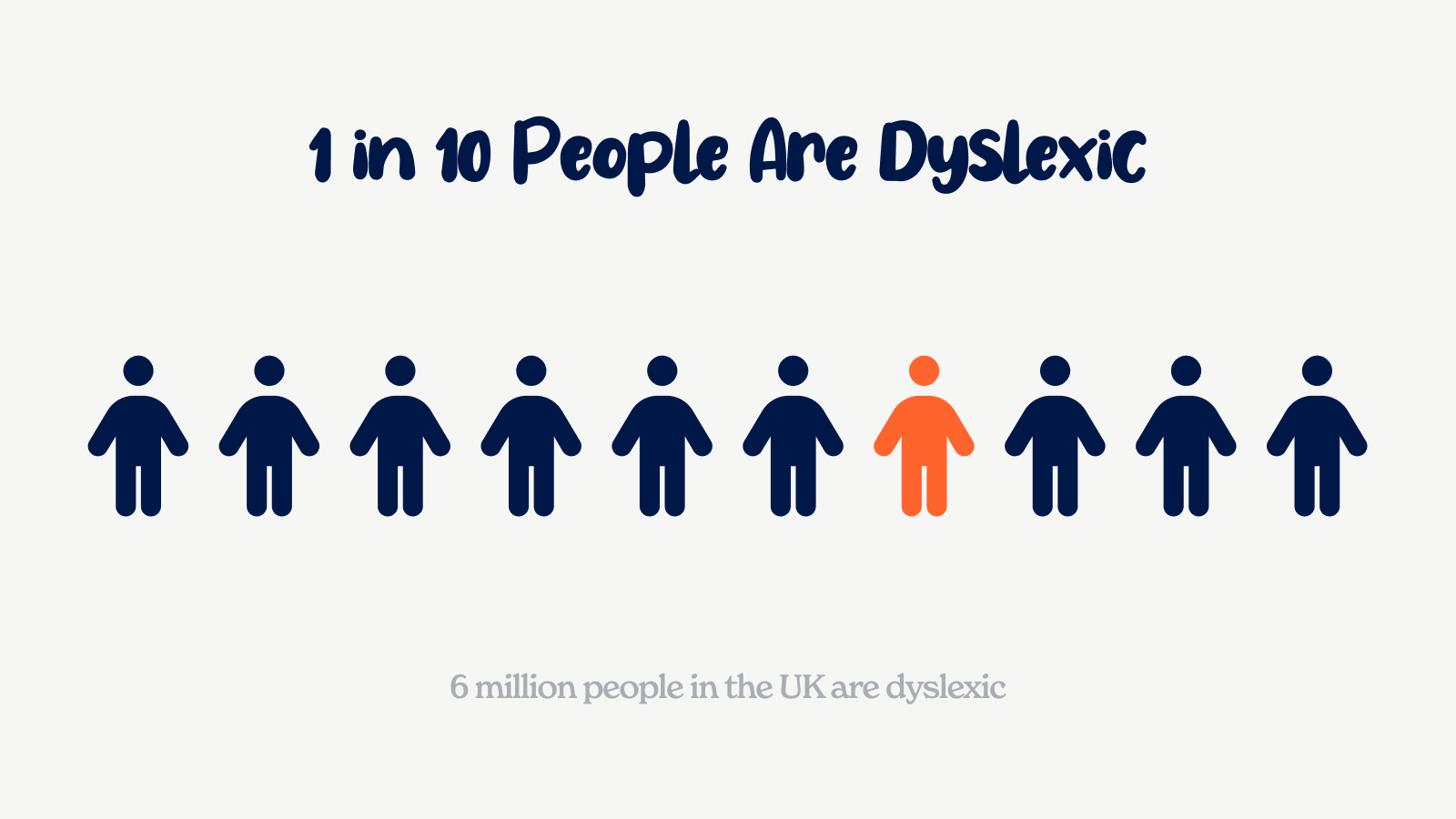
Dyslexia is one of the most common learning differences in the UK, affecting around 1 in 10 people – that's over 6 million individuals!
If you're a parent noticing your child struggling with reading, writing, or spelling, you're not alone. Early detection can make all the difference, turning potential frustration into empowered success.
This comprehensive guide covers dyslexia signs from primary school through to young adulthood, drawing on trusted UK sources like the British Dyslexia Association (BDA), NHS, and Department for Education (DfE).
We'll bust myths, explain symptoms of dyslexia by age and share practical strategies for how to know if your child has dyslexia. Whether your son or daughter is in KS1, or preparing for college, understanding dyslexia early unlocks doors to the right help…
What Dyslexia Really Is (and Isn't)
Dyslexia is a lifelong neurobiological condition that primarily affects reading, writing, and spelling - it's a specific learning disorder that has nothing to do with low intelligence (contrary to popular belief) - and many people with dyslexia are highly creative and successful (think Richard Branson and Keira Knightley).
The BDA defines it as a learning difficulty that mainly impacts the skills involved in accurate and fluent word reading and spelling.
In the UK, dyslexia is recognised under the Equality Act 2010 as a learning disability, entitling individuals to reasonable adjustments in education and work. Family history plays a big role – if a parent has dyslexia, the child has a 40–60% chance, and early spotting is key because undiagnosed dyslexia in children can lead to anxiety, low self-esteem, and academic gaps that widen over time.
According to the BDA, dyslexia exists on a continuum, influenced by genetic and environmental factors, and often involves impairments in phonological awareness, verbal memory, and verbal processing speed.
Dyslexia can co-occur with other conditions like ADHD or dyspraxia, making identification trickier. Importantly, it's not linked to vision problems, although some dyslexic people benefit from coloured overlays for visual comfort.
Early Signs in KS1 (Ages 5–7)
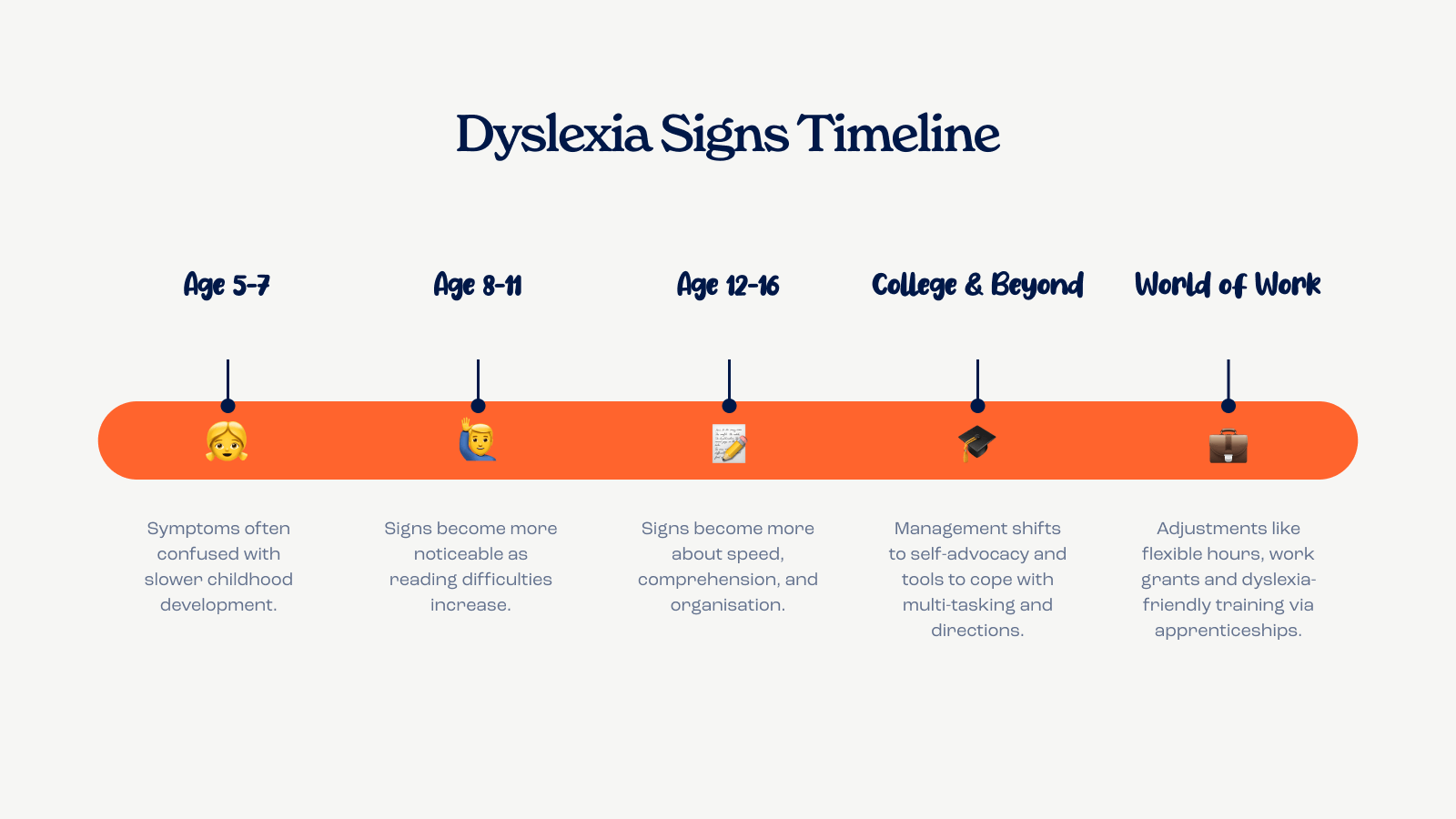
In early primary years, dyslexia often displays itself as subtle delays in language skills, rather than obvious reading problems. At this age, children are just starting phonics, so signs can be mistaken for normal, slower development. However, if multiple indicators persist, it's worth noting.
Some early signs of dyslexia include:
Early reading and phonics struggles
When learning to read, children may:
- Struggle to hear the individual sounds in words (cat = c-a-t)
- Confuse letters with similar shapes (b/d, p/q) beyond age 6
- Find blending sounds unusually difficult
- Struggle to remember common “tricky” words
- Guess words from the first letter rather than decoding them
Example: A child may read “spot” as “stop”, or “dog” as “got”.
Difficulties with rhyming and sequencing
Rhyming is a surprisingly important predictor of reading development. Persistent difficulty with rhyming activities (cat/hat/sat) can indicate phonological issues.
Children may also struggle to:
- Recite sequences (days of the week, numbers, alphabet)
- Learn simple routines
- Follow multi-step instructions
- Confusion between directional words (up/down)
- Poor auditory discrimination (distinguishing similar sounds)
Unusual fatigue during literacy tasks
Parents often describe KS1 dyslexic children as:
- “Trying really hard but getting nowhere”
- “Avoiding reading time at home”
- “Becoming tired or frustrated quickly”
This isn’t laziness - it reflects how much extra effort decoding requires.
Memory-related red flags
Short-term working memory can appear weaker:
- Difficulty remembering more than one instruction
- Forgetting words they learned the day before
- Struggling to retain spellings from week to week
What is normal vs. what is concerning?
Normal: occasional letter reversals, slow reading skills at age 5.
Concerning: consistent difficulties across multiple areas by the end of Year 2 - especially if there is a family history.
NHS guidance notes that dyslexic children may also have coordination issues, like tying laces later than peers. If your child hates storytime or seems frustrated with puzzles, it could be an early clue. Around 1 in 5 children show some of these traits temporarily, but if they cluster and persist beyond Year 1, seek advice.
The BDA emphasises that these behaviours overlap with typical child development, but severity and persistence are key. Early intervention at this stage can prevent later struggles, as phonological skills are foundational for reading.
Signs in KS2 (Ages 8–11)
By mid-primary, dyslexia signs become more noticeable as reading difficulty increases. Children may read slowly or inaccurately, guessing words (especially unfamiliar words) instead of sounding them out, and spelling is often inconsistent – spelling the same word differently in one paragraph.
Inconsistent spelling patterns
A hallmark feature is “scattergun spelling”:
- Spelling the same word differently on the same page
- Dropping vowels
- Reversing sound order (e.g., “frd” for “fried”)
- Persistent errors with high-frequency words despite practice
Reading becomes slow, effortful, or avoided
Children might:
- Avoid books that others their age enjoy
- Choose very easy texts
- Lose their place easily when reading
- Struggle to summarise what they’ve just read
Parents may notice: “They can read a word perfectly one day and forget it the next.”
Difficulties with working memory
Signs often include:
- Problems recalling times tables
- Difficulty copying from the board
- Forgetting instructions
- Struggling with multi-step maths problems
Impact on writing and maths
Dyslexia isn’t just about reading:
- Written work may be short, disorganised, or missing punctuation
- Children may struggle with word problems in maths
- Longer homework tasks may feel overwhelming
- Reversing numbers/letters
Growing self-consciousness
By upper KS2 (Years 5–6), children become more aware of differences. Impact on self-esteem starts here and children may call themselves "stupid" or start to withdraw from classroom interactions.
Without support, this can lead to anxiety around class reading or tests. If these signs appear consistently across the year, it’s worth requesting a discussion with the SENCo or exploring a dyslexia screening.
KS2 summary
Children may excel orally but struggle to put thoughts on paper.
According to the NHS, these years are when dyslexia can affect broader learning, like history timelines or science experiments requiring sequencing. If SATs prep highlights gaps, this is a common trigger for assessment.
The DfE notes that dyslexia can co-occur with ADHD (difficulties in concentration) or dyspraxia (difficulties with motor skills), which amplifies challenges.
Dyslexia Signs in KS3/4 (Ages 12–16)
In secondary school, dyslexia evolves – it’s less about basic decoding, and more about speed, comprehension, and organisation. Teens may read aloud hesitantly, omitting words, or have low understanding despite effort. Spelling remains erratic, and note-taking is slow.
The NHS highlights increased emotional impact in this age bracket. Frustrations heighten and GCSE pressure amplifies anxieties – undiagnosed teens risk disengagement. The BDA also notes that at this age, dyslexia can lead to behavioural issues if unsupported.
Slow reading and processing
Teens may:
- Read significantly more slowly than peers
- Have difficulty keeping up with dense textbooks
- Show limited retention unless they re-read sections
- Confuse in subject-specific vocabulary
This affects revision, comprehension, and exam timing.
Challenges with essay structure and planning
Writing issues may include:
- Difficulty planning essays
- Struggling to organise thoughts in a logical sequence
- Short, simplified responses despite good verbal ability
Difficulties with foreign languages
Many teens report that French, Spanish, or German feel especially hard, often because of:
- Memorising vocabulary
- Grammar rules
- Spelling in another language
Increasing anxiety around tests
As GCSEs approach, difficulties can show as:
- Exam panic
- Difficulty with multi-step maths
- Challenges with revision planning
- Trouble revising from notes
- Avoiding reading-heavy subjects
- Fear of reading aloud in class
Self-advocacy becomes important
KS3/4 is when children learn to explain their needs - extra time, coloured overlays, use of a laptop. Understanding their dyslexia helps teens build long-term confidence.
Managing Dyslexia as a Young Adult
As teens become young adults, dyslexia management shifts to self-advocacy and tools. Young adults may struggle with long texts, multi-tasking, or directions, but strengths like creativity shine.
Strategies include assistive tech: text-to-speech (e.g., NaturalReader app), mind-mapping apps (e.g., MindMeister), and time trackers. BDA recommends breaking tasks down and using calendars . Emotional coping: mindfulness for stress, joining support groups.
In college, dyslexia can affect note-taking or essays, but adjustments like extra time help. An 18-year-old might use Dragon dictation for reports or audiobooks for study. Success stories show dyslexics excelling in entrepreneurship – focus on strengths .
Daily management: use colour-coded notes, voice memos for ideas, and apps like Pocket for saving articles to listen to later. Building self-esteem is key – many young adults thrive once they embrace dyslexia as a difference, not a deficit.
Dyslexia and Support After School (College & Beyond)
Post-GCSE, dyslexia doesn't disappear, but support evolves. In college (FE), the SEND Code of Practice ensures adjustments like exam concessions or specialist tutoring.
For university, Disabled Students' Allowance (DSA) funds tech, mentoring, up to £27,783/year for 2025/26. BDA notes 1 in 5 HE students is dyslexic – adjustments include recorded lectures, extended deadlines.
In work, the Equality Act protects rights: reasonable adjustments like speech software or flexible hours. Access to Work grant covers aids. Apprenticeships offer dyslexia-friendly training.
Support includes workplace coaching, apps like SnapType for scanning notes, and organisations like BDA for advocacy. The key is self-disclosure – many employers value dyslexic thinking for innovation.
Long-term: many dyslexic individuals thrive in visual/creative fields.
When (and How) to Get Tested & Diagnosed
If signs persist, seek assessment early. For KS1–KS2, start with school SENCO – they can screen and refer to educational psychologists (free via NHS/school). Waiting times: 6–18 months .
Private testing: £500–£800, faster . For teens/adults, workplace/college referrals are common. Assessment involves interviews, IQ tests, reading tasks – 2–3 hours.
Home Strategies & Support
While waiting, try multi-sensory learning: coloured overlays for reading, phonics games. Apps like Nessy or audiobooks via Audible. For teens, mind-maps, voice-to-text. Learning Cubs offers SEND-focused clubs with dyslexia strategies – small groups for reading confidence.
How Learning Cubs can help
Learning Cubs’ SEND-focused tuition provides:
- 1:1 and small-group support
- Specialist reading and spelling interventions
- Confidence-building activities
- A safe, nurturing environment
- Tailored learning plans developed by SEND specialists
If you’re concerned about your child’s reading, spelling, or learning confidence, early support can make a transformative difference.
Learning Cubs provides SEND-informed tuition, structured literacy interventions, and a warm, encouraging environment that helps children thrive.
Parents often tell us that after just a few sessions, their child becomes more confident, more engaged, and far happier tackling reading and writing.
You don’t need a diagnosis to start getting support - and you don’t have to navigate this alone.
👉 Book a free assessment with Learning Cubs to chat about your child’s needs and the support available in your nearest centre.
FAQs
Can my child grow out of dyslexia?
No, dyslexia is a lifelong neurobiological condition. However, with the right intervention and support strategies, the challenges associated with reading and writing can be significantly managed and reduced.
Is dyslexia linked to lower intelligence?
Absolutely not. Dyslexia has no relationship with overall intelligence (IQ). Many dyslexic individuals are highly intelligent, creative, and gifted in areas outside of standard literacy.
Is dyslexia hereditary?
Yes, it runs strongly in families. Studies suggest that if one parent has dyslexia, there is a 40%–60% chance their child will also have it since dyslexia runs in families as a hereditary learning disorder.
Can my child do GCSEs with dyslexia?
Yes – with extra time (up to 25%), readers, or laptops.
How do Learning Cubs help with dyslexia?
Our clubs use multi-sensory methods for reading/spelling, and our tutors are trained in SEND support so they can offer bespoke resources and one-to-attention to children.
Will my child always struggle with reading?
Not necessarily. While they may always read slower than an average reader, or find reading tiring, many dyslexics become competent, functional readers who enjoy books, especially when they learn to decode properly through structured phonics intervention.
My school says my child is too young to be tested. Is this true?
While formal diagnostic assessments are often more reliable after age 7, early screening for "at-risk" indicators can be done in Early Years. Waiting for a child to "fail" before offering support is outdated; early intervention is key.


.png)

.png)


