


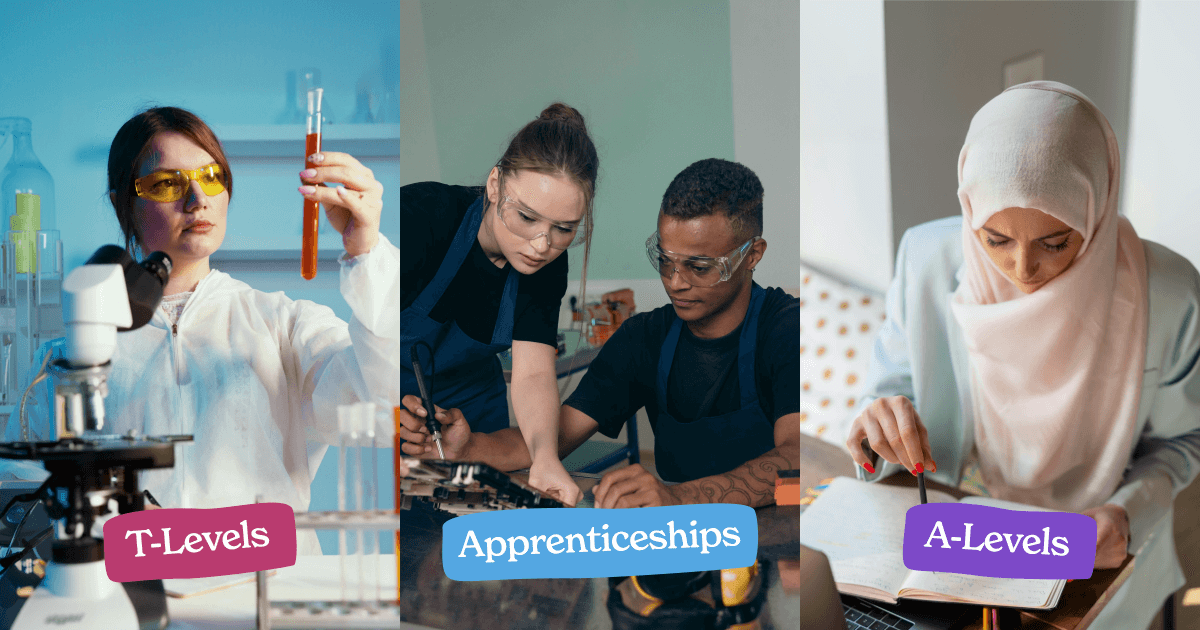
It is the conversation happening at kitchen tables across the UK right now with every 15 and 16-year-old. The leaflets are coming home, the college open days are filling up the calendar, and the pressure is mounting.
"What are you doing next year?"
For a generation of parents, the answer is simple. You did your GCSEs, then A-Levels at Sixth Form through your school or college, and then you went to University. That was "The Path." Anything else was often viewed as a fallback option for those who didn't quite make the grades.
But if you are parenting a child in the Class of 2026, you need to tear up that old map. The landscape has shifted dramatically. As you and your child plan their GCSE next steps, you will find that the "University or Bust" model is officially dead.
In its place is a dynamic, three-pronged system where a vocational qualification route can now lead to a higher salary than a traditional degree, and where classroom learning is being revolutionised by industry partnerships.
However, with choice comes confusion. Is an apprenticeship a good idea for an academic child?
However, with choice comes confusion:
- What exactly is a T-Level - what are these new technical qualifications?
- Are apprenticeships really competitive?
- And are A-Levels still the gold standard they used to be?
This comprehensive guide breaks down the "Big Three" pathways for 2026 school leavers, helping you match your child’s learning style to the right future and evaluate A-Levels vs Apprenticeships vs T-Levels.
Let’s dive in:
1. A-Levels: The Traditional Academic Route
The Headline: Deep theoretical study for the exam-focused academic.
Despite the rise of new competitors, A-Levels (Advanced Levels) remain the most popular route for UK school leavers. They are the direct successor to GCSEs, usually studied at a Sixth Form or a dedicated Sixth Form College.
How They Work in 2026
Students typically choose three subjects (sometimes four, if they are particularly ambitious and include Further Maths) to study over two years.
Unlike the modular A-Levels of the past, modern A-Levels are linear. This is a crucial distinction for parents to understand. It means your child’s entire grade rests on the exams they sit at the end of the two years. For students sitting A-Levels 2026, there are very few opportunities to "bank" marks along the way.

The "Facilitating Subjects" Strategy
If your child has their heart set on a prestigious Russell Group university, you need to know about "facilitating subjects." These are the subjects that universities most frequently require for entry.
While Media Studies or Psychology are fantastic subjects, top-tier universities often look for at least one or two "hard" subjects to prove academic rigour. These include:
- Mathematics and Further Mathematics
- English Literature
- Physics, Biology, Chemistry
- History
- Geography
- Modern Languages
The Pros of A-Levels
- University Access: They are universally understood and accepted by every university in the world, from Oxford to Harvard.
- Keeping Options Open: If your child has no idea what career they want (which is normal at 16!), A-Levels keep them in the widest possible holding pattern. History A-Level can lead to Law, Journalism, Politics, Teaching, or Management.
- The Social Aspect: Sixth Forms often retain a "school-like" community feel, which can be a gentler transition than a massive Further Education college.
The Cons of A-Levels
- The "Pressure Cooker": The linear structure is unforgiving. If your child suffers from high exam anxiety or struggles to retain information over 24 months, A-Levels can be a mental health minefield.
- Theory Heavy: They are academic, not practical. You learn about Business, you don't do Business.
Who is this route for?
A-Levels are best for the Deep Diver.
This is the student who actually enjoys the revision process, likes debating big ideas, writes strong essays, or loves solving abstract mathematical problems. If your child asks "Why?" more than "How?", A-Levels are their natural home.

2. T-Levels: The "New Power Player"
The Headline: The modern hybrid: 80% classroom, 20% career.
T-Levels (Technical Levels) are the government's flagship qualification designed to bridge the gap between A-Levels and Apprenticeships. Launched in 2020, they will be fully mature by the time the Class of 2026 starts.
One T-Level is equivalent to three A-Levels. It is a full-time, two-year programme that carries the same UCAS points as getting three A grades.
The "80/20" Split
This is the unique selling point of a T-Level.
- 80% Classroom: Your child spends most of their time in college learning the theory. This gives them the academic rigour and the "student life" experience.
- 20% Industry Placement: This is not just a week of making tea. It is a substantial 45-day placement (minimum 315 hours) with a real employer. They work on actual projects, use industry-standard software, and treat the workplace like a job.
T-Levels vs A-Levels: The Key Difference
The main debate for many parents is T-Levels vs A-Levels. The deciding factor is usually assessment style. While A-Levels are almost entirely exam-based, T-Levels include practical employer-set projects. If your child struggles with the pressure of a pure exam hall but thrives when given a practical problem to solve, T-Levels offer a better balance.
New Subjects for 2026
The list of available subjects has grown significantly. For students starting in September 2025/26, the menu is expanding to include new options like Marketing. The full list of T-Level subjects now includes:
- Digital: Digital Production, Design & Development (Coding), and Digital Business Services.
- Construction & Engineering: Civil Engineering, Surveying, and Design.
- Health & Science: Nursing, Laboratory Science, and Healthcare Science.
- Business: Management & Administration (HR, Team Leadership).
- Legal: Legal Services (a new route into Law).
- Creative: Media, Broadcast and Production (started late 2024, fully rolled out by 2026).
- Agriculture: Land Management and Production.
Do Universities Accept Them?
This is the most common question we get at Learning Cubs. The short answer is: Yes, mostly.
Currently, over 160 UK higher education providers accept T-Levels for entry, including many Russell Group institutions like Exeter, York, and Warwick.
However, there is a caveat. Some ultra-traditional courses (like Theoretical Physics at Imperial) may still prefer A-Levels. But for courses aligned with the T-Level (e.g., a Computer Science degree after a Digital T-Level), admissions tutors often love T-Level students because they already know how to code in a professional environment.
Who is this route for?
T-Levels are best for the Applied Learner.
This is the student who is smart and capable but gets bored by pure theory. They want to see the point of what they are learning. If your child learns best by doing a project rather than reading a textbook, but isn't quite ready to leave education for a full-time job, the T-Level is the perfect "Goldilocks" middle ground.

3. Apprenticeships: The "Debt-Free Degree"
The Headline: A real job with a salary, bypassing student debt entirely.
Forget the old stereotype of apprenticeships being only for manual trades. While those trades are still vital and valuable, the modern apprenticeship landscape includes Law, Cyber Security, Accounting, Aerospace Engineering, and Architecture.
Understanding the Levels
It is crucial to apply for the right level, or your child will be rejected immediately.
- Level 2 (Intermediate): These are often referred to as GCSE apprenticeships. They are equivalent to 5 GCSE passes and are excellent for students who need to rebuild confidence or gain foundational skills in a trade.
- Level 3 (Advanced): Equivalent to 2 A-Levels. This is the standard entry point for most 16-year-old school leavers entering corporate roles.
- Level 4/5 (Higher): Equivalent to a Foundation Degree.
- Level 6/7 (Degree Apprenticeship): Equivalent to a Bachelor’s or Master’s Degree.
The Degree Apprenticeship Revolution
This is the "Golden Ticket" of modern education. In a Degree Apprenticeship, your child works for a company (like Rolls-Royce, BBC, Google, or the NHS) for four days a week and studies at a university for one day a week.
- They earn a salary: Usually between £18,000 and £24,000 to start.
- They pay £0 fees: The government and employer pay the tuition.
- They graduate with experience: At 21, they have a degree and 4 years of work experience. A traditional graduate has a degree and debt.
Trend Watch 2026
The landscape for apprenticeships 2026 is looking robust. According to recent government statistics on apprenticeships, starts in Degree Apprenticeships (Level 6 and 7) have continued to grow year-on-year, proving their exploding popularity.
Furthermore, new funding rules effectively restrict Level 7 funding to young people aged 16-21, meaning the government is actively prioritising your child's demographic for these high-level opportunities.
The "Hidden" Difficulty
Here is the hard truth: Getting a good apprenticeship is harder than getting into Oxford.
For a top-tier scheme (like the Airbus or J.P. Morgan programmes), there might be 50 applicants for every place, making entry requirements robust.
- There is no "guaranteed place" like with a college.
- Your child has to pass assessment centres, psychometric tests, and multiple interviews.
- They need to be resilient. Rejection is part of the process.
Who is this route for?
Apprenticeships are for the Mature Self-Starter.
You cannot "float" in an apprenticeship. You are an employee first, a student second. If your child is organised, articulate, ready to leave the school playground dynamics behind, and motivated by money, independence and hand ons experience, they will thrive here. If they still need someone to remind them to bring a pen to class, they are not ready for this.

The Comparison Matrix: A Quick Reference
Struggling to visualise the difference? Use this table to compare the three routes side-by-side.
Feature
A-Levels
T-Levels
Apprenticeships
Duration
2 Years
2 Years
1–5 Years (Level dependent)
Structure
100% Academic / Classroom
80% Classroom / 20% Work
80% Work / 20% Study
Assessment
Mostly exams at the end
Exams + Employer Projects
on-the-job assessment + "End Point Assessment"
Cost
Free (state) / Paid (private)
Free
Free + You get paid a salary
UCAS Points?
Yes
Yes (Distinction* = 3 A*s)
Not usually relevant (you are already employed)
University Access
Excellent (The standard route)
Good (Check specific courses)
You can do a Uni degree within the apprenticeship
Best For...
The Theorist
The Project Manager
The Young Professional
A Note on BTECs (The "Fourth" Option)
You may have heard of BTECs. Historically, these were the main vocational alternative to A-Levels.
Important Warning: The government is currently phasing out funding for many BTEC courses that overlap with T-Levels. Popular BTECs in subjects like Health & Social Care and IT are set to be defunded from 2026 onwards to streamline the system. If a college offers a BTEC, check carefully if it is being replaced by a T-Level. T-Levels are generally seen as the more "future-proof" qualification now.
The "Northern" Advantage
For families in the North, the apprenticeship and T-Level routes are particularly exciting.
Whilst the gap is clear and London dominates in finance, the North is becoming the UK’s capital for Clean Energy, Advanced Manufacturing, and Digital Tech.
- Sheffield & Rotherham: The Advanced Manufacturing Park is a global hub for engineering apprenticeships (McLaren, Boeing, Rolls-Royce).
- Manchester & Leeds: Major hubs for Digital T-Levels and legal apprenticeships.
- Automotive: The shift to electric vehicles is creating thousands of technical roles that require the practical skills taught in T-Levels, not just the theory of A-Levels.
Choosing a technical route in the North is often a direct pipeline into the region's fastest-growing industries, bypassing the traditional hurdles.
A Timeline for Parents: What to Do and When
If your child is in Year 10, relax. Use this time to visit different types of providers. Go to a Sixth Form open evening and a College open evening just to feel the difference in atmosphere.
If your child is in Year 11, the clock is ticking.
September – December 2025 (The Research Phase):
- Attend Open Days.
- Top Tip: Don’t just speak to the teachers. Ask the current students: "How much support do you actually get?" and "Is the food decent?" (It matters!).
- Start drafting a CV if considering apprenticeships.
January 2026 (The Application Phase):
- College/Sixth Form: Most applications should be in by late January/February. It is usually a simple online form.
- Apprenticeships: The "hiring season" for big companies often starts now. Check sites like Amazing Apprenticeships or Find An Apprenticeship weekly.
- The Golden Rule: Always apply for a college place as a backup. Even if your child is 100% sure they want an apprenticeship, secure a college offer. If they don't get the job, they need a safety net.
May 2026 (Exam Season):
- GCSEs begin. All offers (College and Apprenticeship) will be "Conditional." This means they are dependent on getting specific grades (usually Maths and English are non-negotiable).
August 2026 (Results Day):
- Confirm the place or enter the "Clearing" process if grades were unexpected.
It All Starts with the Grades
Whether your child wants to study History at Oxford, code for Google, or engineer wind turbines, there is one common denominator: GCSE English and Maths.
- A-Levels: You usually need a 6 or 7 in the subject you want to study.
- T-Levels: You need a 4/5 in Maths and English to handle the technical content.
- Apprenticeships: Major employers will filter out any CV that doesn't have a 4 or 5 in Maths and English. It is an automatic "No."
The best investment you can make right now, in the middle of Year 11, is securing those foundational grades.
Is your child’s Maths or English grade currently borderline?
Don't let a grade 3 close the door to a dream career. At Learning Cubs, we specialise in the targeted, high-impact revision needed to turn a "nearly there" into a "solid pass."
Book a Year 11 Booster Assessment Today – Let’s make sure they have the keys to unlock whichever door they choose.


