For parents of children in Year 4 and Year 5, the term "11 Plus" can induce an immediate sense of anxiety. The group chats start buzzing with recommendations, panic sets in about vocabulary lists, and suddenly, everyone seems to be hiring a private tutor.
If you are aiming for a grammar school or a highly selective independent school, you are likely asking yourself: is 11 plus tutoring worth it?
The short answer is yes.
The 11+ is not a standard curriculum test. It is designed to identify the top 20-30% of academic ability in a given cohort, assessing skills like Non-Verbal Reasoning that are rarely taught in standard primary school classrooms. Relying solely on your child’s primary school to prepare them is a risky strategy.
However, finding the right support is a minefield. Type "11 plus tutors near me" into Google, and you will be overwhelmed by the choices. How do you distinguish between a genuine 11+ expert and a general tutor looking to fill their timetable?
This comprehensive guide will break down exactly what to look for in an 11+ tutor, explain the complex terminology of the exams, provide strategies to manage 11+ exam stress, and help you make an informed decision for your child’s future.
1. The Reality Check: Grammar School Competition
Before hiring a tutor, it is vital to understand the landscape you are entering. The grammar school competition in the UK is fierce.
Many parents assume that a bright child who achieves "Greater Depth" in their Year 6 SATs will naturally pass the 11+. Unfortunately, this is a misconception. The 11+ requires a different type of cognitive processing and a rapid pace that many academically gifted children simply haven't practiced.
The Tuition Gap
To understand the competitive nature of these exams, we can look at the data regarding private tuition.
According to extensive educational research by the Sutton Trust, there is a significant divide in preparation:
- 70% of grammar school entrants have received some form of private tutoring to help them pass the exam.
- Only 10% of students in non-selective state schools received equivalent private tuition.
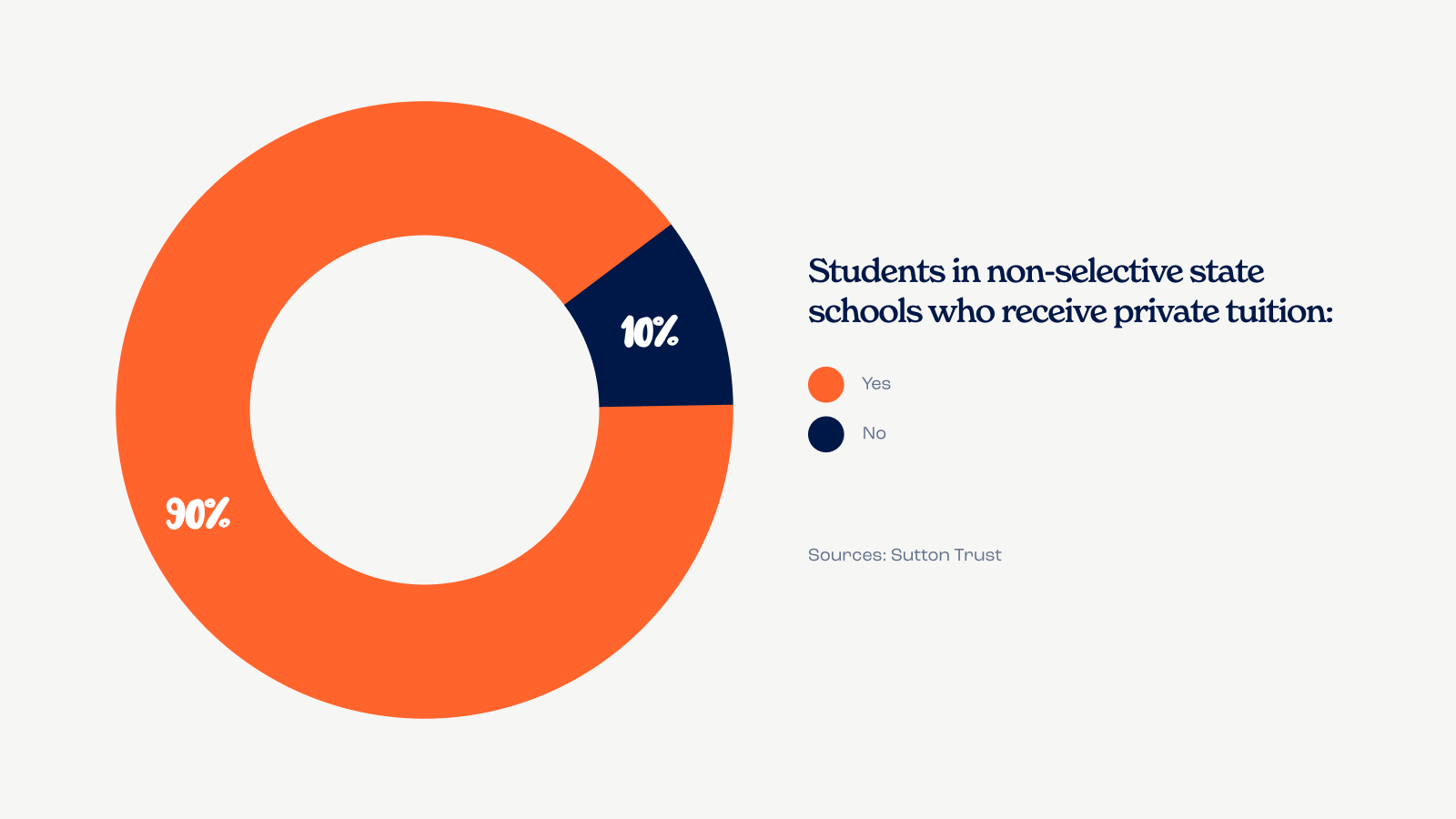
This data highlights a stark reality: your child is competing against a cohort that has been professionally prepared. To level the playing field, high-quality grammar school tuition is often a necessary investment. For more information on national school admissions policies, you can always consult the Gov.uk School Admissions guidelines.
Decoding the Exams: GL & CEM Exam Preparation
One of the biggest mistakes parents make is hiring a tutor without knowing which exam their local schools use. An expert tutor should immediately ask you which schools you are targeting because the exam boards vary drastically.
The two main exam boards for the 11+ in the UK are GL Assessment and CEM (Centre for Evaluation and Monitoring). A good tutor must provide targeted GL and CEM exam preparation.
Here is what you need to know about the difference:
GL Assessment (Granada Learning)
The GL 11+ is the more traditional of the two exams. It was previously known as NFER.
- Structure: Subjects are typically split into separate papers: English, Maths, Verbal Reasoning, and Non-Verbal Reasoning.
- Format: Most questions are standard multiple-choice.
- Predictability: GL is known for being somewhat predictable. Because the question types rarely change, children can be heavily coached on the specific methods required to solve them. You can learn more about their specific testing methods on the official GL Assessment website.
CEM (Centre for Evaluation and Monitoring)
CEM was introduced specifically to be "tutor-proof" (though in reality, no exam is entirely tutor-proof). It is designed to test a child's natural academic potential rather than their ability to memorize question types.
- Structure: CEM does not separate subjects neatly. A single paper might mix Maths, Non-Verbal Reasoning, and English comprehension. Sections are strictly timed; a child might have exactly 6 minutes to finish a vocabulary section before being told to turn the page.
- Focus: CEM relies incredibly heavily on a broad vocabulary and strong reading skills.
- Predictability: Highly unpredictable. The weighting of subjects and the types of questions change from year to year to prevent coaching.
The Golden Rule: If a tutor tells you they teach a "general 11+ curriculum" without asking which exam board your local grammar school uses, walk away.
When to Start 11 Plus Preparation 🤔📆
Timing is a delicate balancing act. Start too late, and your child will be overwhelmed by the sheer volume of new information. Start too early, and they will burn out before they even reach Year 6.
So, when to start 11 plus preparation?
The Ideal Timeline: January of Year 4
For most children, 18 to 20 months before the exam (which takes place in September of Year 6) is the "Goldilocks" zone.
- Year 4 (Spring/Summer): This phase is not about doing exam papers. It is about building the foundation. A good tutor will use this time to expand vocabulary, solidify times tables, and introduce the strange new concepts of a verbal reasoning tutor (like decoding ciphers or finding hidden words). As we noted in our recent guide on Making Maths Fun Again, foundational numeracy must be rock solid before attempting 11+ algebra or complex ratios.
- Year 5 (Autumn/Winter): The pace increases. The tutor should start teaching specific exam techniques, time management, and tackling multi-step word problems.
- Year 5 (Spring/Summer): The focus shifts strictly to exam practice. This is the time for past papers, timed conditions, and targeting weak spots.
4. What to Look for in an 11+ Tutor: The Ultimate Checklist
When interviewing potential tutors or visiting tuition centres, keep this checklist in mind. A professional should be able to confidently address all of these points.
✅ Proven Track Record and Local Knowledge
An 11+ tutor must be an expert in your specific geographical area. The pass mark for a grammar school in Kent is different from a grammar school in Trafford or Birmingham.
- Ask: "What is your success rate for [Insert Specific Target School]?"
- Ask: "Are you familiar with the specific admissions criteria and format for this year?"
📚 High-Quality, Board-Specific Resources
A tutor should not be relying on generic worksheets printed from the internet. They should have a structured curriculum of resources specifically tailored to GL or CEM.
- Look for: Tutors who use recognized publishers (like CGP or Bond) in conjunction with their own proprietary materials.
💬 A Focus on Verbal and Non-Verbal Reasoning
Primary schools teach Maths and English. They do not teach Verbal and Non-Verbal Reasoning. Your child will need to learn how to identify 3D shapes from 2D nets, solve mirror-image puzzles, and crack letter codes. Ensure the tutor has a robust strategy for teaching these specific, alien concepts.
📝 Regular 11+ Mock Exams
This is perhaps the most critical component. A child might be brilliant at solving a math problem in the quiet of their own kitchen, but they might freeze in a hall with 200 other nervous children while a clock ticks down.
- What to look for: A tutor or centre that offers formal 11+ mock exams under strict, exam-hall conditions. This desensitizes the child to the environment and teaches them crucial time-management skills.
Identifying the Red Flags: When is a Tutor the Wrong Fit?
Even highly qualified teachers can be the wrong fit for your child. The 11+ journey is stressful, and the wrong tutor can exacerbate that anxiety.
If you have a child struggling with 11 plus preparation, look out for these red flags:
- The "Pressure Cooker" Approach: If the tutor uses fear or intense pressure to motivate your child, it will backfire. 11+ exam stress is real, and a good tutor builds confidence; they don't break it down.
- Lack of Feedback: You should never be in the dark about your child's progress. If the tutor cannot pinpoint exactly what your child's weak areas are (e.g., "She is great at algebra but losing marks on complex vocabulary synonyms"), they are not tracking their data closely enough.
- The "One Size Fits All" Guarantee: No honest tutor can guarantee a pass. The exam is highly competitive and depends on how the child performs on the day. Beware of anyone offering a 100% guarantee.
Private Tutor vs. Tuition Centre: Which is Better?
Parents often debate whether to hire a private 1-on-1 tutor to come to their house or to enroll their child in a tuition centre.
The Private Tutor:
- Pros: 100% individual attention; entirely personalized pacing.
- Cons: Can be incredibly expensive; the child misses out on the peer-learning environment; they don't experience the "exam hall" feel of working alongside others.
The Tuition Centre (Like Learning Cubs):
- Pros: Often more cost-effective; provides a structured curriculum; children realize they are not alone in the process (peer motivation is powerful!); centres have the facilities to host large-scale mock exams.
- Cons: Larger groups mean less individual focus (which is why you must ensure the centre strictly limits its class sizes - we sit 6 students with one tutor).

For many families, a high-quality tuition centre offers the perfect balance of expert instruction, structured resources, and a healthy, competitive but supportive peer environment.
How Learning Cubs Can Help
The 11+ is a marathon, not a sprint. It requires dedication from the child, support from the parents, and expert guidance from a professional.
At Learning Cubs, our 11+ Tuition Programme is designed to remove the guesswork and the stress from the process. We don't just teach children how to pass a test; we equip them with the advanced literacy, numeracy, and critical thinking skills that will serve them throughout their entire secondary education.
Why choose Learning Cubs for your 11+ journey?
- Targeted Expertise: We thoroughly prepare students for both GL and CEM formats, depending on your local grammar school requirements.
- Small Focus Groups: Your child gets the benefit of peer learning without ever getting lost in the crowd.
- Mock Exam Practice: We run regular, timed assessments to build stamina and conquer exam-day nerves.
- Confidence First: We believe that a confident child is a successful child. Our tutors are mentors who build resilience alongside academic skills.
Don't leave their grammar school chances to guesswork.
If you are searching for expert 11 plus tutors near me, your search ends here.
Book a FREE Assessment at your local Learning Cubs centre today!
Let us map out a personalized success plan for your child.
FAQs
Is 11 plus tutoring worth it if my child is already doing well at school?
Yes. Primary schools follow the National Curriculum, which does not cover Verbal or Non-Verbal Reasoning. Furthermore, the 11+ tests concepts at a level usually expected of early Year 7 or Year 8 students. Even exceptionally bright children need to learn the specific techniques and time-management skills required for this unique exam.
How can I help manage my child's 11+ exam stress?
Keep communication open. Frame the 11+ as an "opportunity" rather than a "must-pass" event. Ensure they have plenty of downtime, maintain their hobbies, and praise their effort rather than their scores on practice papers. If the stress becomes overwhelming, speak to your tutor about adjusting the workload.
What happens if my child fails the 11+?
It is vital to have a "Plan B" that you speak about positively. If they do not pass, the advanced Maths and English skills they learned during their 11+ preparation will put them at the top of their class in their comprehensive secondary school. The knowledge is never wasted.
Should we focus on Verbal Reasoning or Maths?
Both are critical, but many tutors advise heavily prioritizing vocabulary and Verbal Reasoning early on. Maths concepts can be taught relatively quickly in Year 5, but building a broad, advanced vocabulary takes years of consistent reading and practice.


.png)