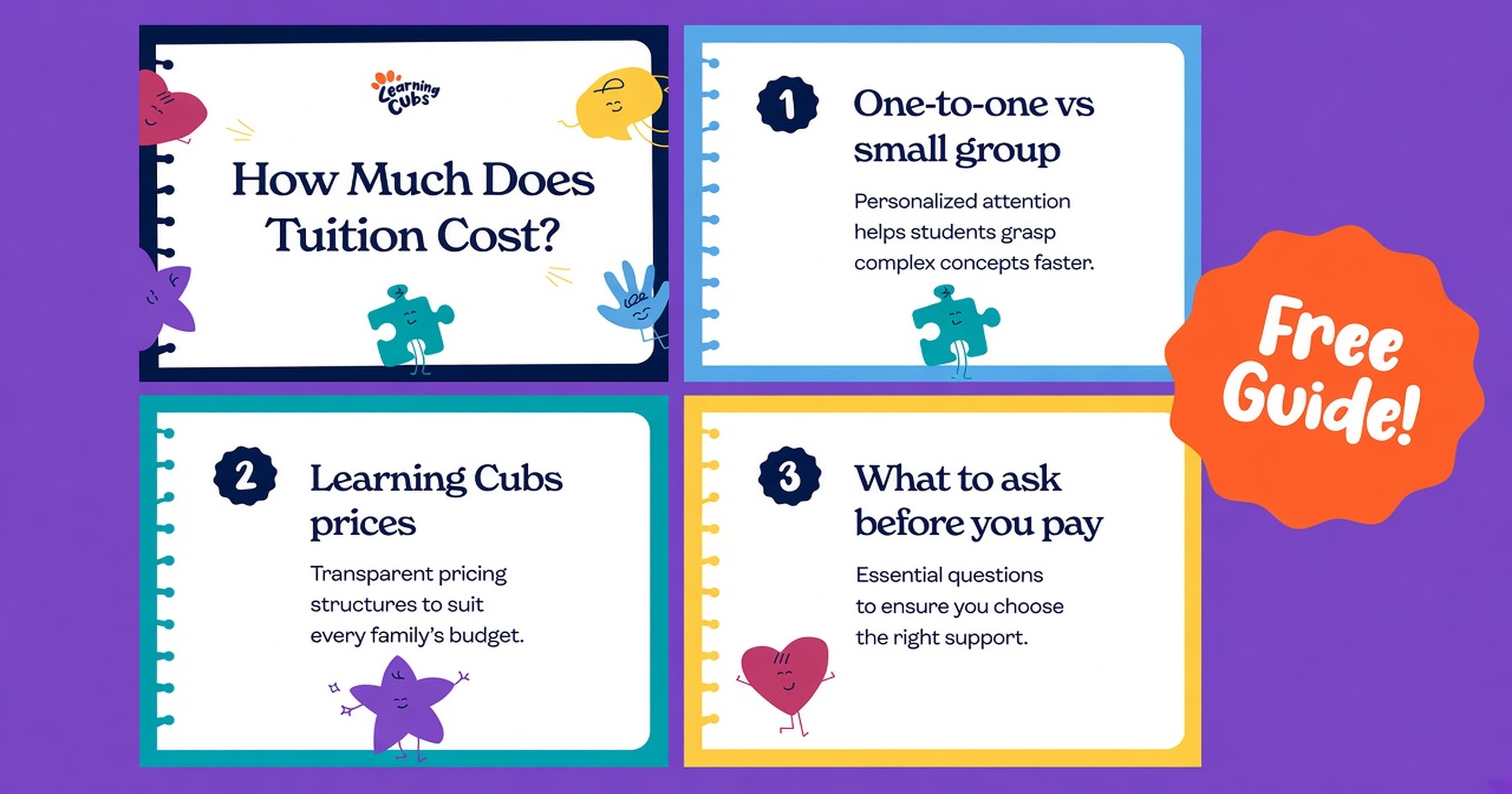
There is no official national price for tuition in the UK. What you pay depends on how the lessons are delivered (one-to-one or small group), who teaches them, the subject and stage, where you live, and whether anything is charged on top of the hourly rate. Families commonly see one-to-one rates from the mid-£20s to £60+ an hour, while small-group tuition is usually cheaper per child because the tutor's time is shared.
This guide walks through why prices vary so much, what different types of provider typically charge, how quality and format affect value, what a year of tuition can add up to, and where Learning Cubs sits — with subsidised small-group rates of £10 an hour (KS1 to KS4) and £15 an hour (11+), plus fully funded places for eligible families.
1. Why do tuition costs vary so much?
Pricing tuition is a bit like pricing a car: the badge on the door matters less than what you actually need under the bonnet. A child who needs a short burst of SATs confidence-building is a very different brief from a Year 10 aiming for a grade 7 in GCSE Maths — and the market prices those differently.
Format: one-to-one vs small group
One-to-one is almost always the most expensive option per hour, because one family pays for the tutor's whole time. Small-group tuition spreads that cost. The EEF estimates one-to-one tuition adds about five months' additional progress over a year, and small-group tuition about four months' — so the learning gain is similar, while the cost per family is usually much lower in a group. Effectiveness drops once groups grow beyond about six or seven children.
Who is teaching
Broadly, parents see bands like this for one-to-one:
- Student or early-career tutors — often around £15–£30 an hour
- Graduates and experienced tutors — commonly £25–£45 an hour
- Qualified teachers — often £40–£60+ an hour
- Specialists (11+, Oxbridge, SEN, high-demand subjects) — frequently £50–£100+
Those are typical ranges from parent guides and marketplace data, not fixed prices. A cheaper tutor is not automatically worse, and an expensive one is not automatically better — fit, clarity of goals and how lessons link to school matter more than the headline rate alone.
Subject and stage
Exam-focused work (11+, GCSE, A-level) often costs more than general primary support. Specialist subjects and entrance exams sit at the top of the range. On platforms such as Tutorful, advertised averages for popular GCSE subjects often land in the mid-£40s an hour online; primary support is usually a little lower.
Location and delivery
London and the South East usually sit above the national median. One large 2026 analysis of historic UK tutor listings put the national median around £30 an hour and the London median around £40 (Tutorperch UK Private Tutoring Rate Report 2026). Online lessons remove travel but do not always cost less — some platforms' averages are similar to, or above, in-person rates because you are paying for vetted tutors and the booking platform.
What else is on the invoice
Ask what the hourly rate includes. Some providers add registration fees, materials, deposits, cancelled-lesson charges or platform commission baked into the price you see. Others — including Learning Cubs — charge only the hourly rate, with a free first assessment and no registration or materials fees.
2. The main ways families buy tuition (and what they usually cost)
Think of this like choosing between DIY, freelancer and agency for a website: each route has a different mix of price, control, quality control and time.
Private one-to-one (independent tutor)
Typical cost: roughly £25–£60 an hour for most school subjects; specialists higher.
Best when: your child has a very specific gap, needs a flexible timetable, or works best 1:1.
Watch-outs: you are responsible for checking references, safeguarding, lesson planning and whether progress is actually happening. Quality varies widely. A year's weekly hour at £40 is about £1,600–£2,000 before holidays.
Online tutoring platforms
Typical cost: often from the mid-£20s an hour upwards. MyTutor lists tutors from about £26 an hour; Tutorful reports many GCSE averages in the mid-£40s. You usually pay an all-in rate that includes the platform.
Best when: you want vetted tutors, easy scheduling, and no travel.
Watch-outs: less face-to-face rapport for some children; you still need to choose carefully; weekly costs add up fast if you book multiple subjects.
Tuition centres and small-group programmes
Typical cost: often around £10–£25 per child per hour for small groups, depending on group size and whether the place is subsidised.
Best when: you want structured weekly support, peer learning, and a lower cost than one-to-one without giving up a trained tutor.
Watch-outs: group size matters. Ask how many children are in the room, how progress is assessed, and whether teaching links to what school is doing. Groups above six or seven are usually less effective.
Agencies and premium specialists
Typical cost: often £40–£100+ an hour for one-to-one, especially for 11+, scholarship or high-stakes exam prep in expensive areas.
Best when: you want the agency to match, manage and quality-assure the tutor for you.
Watch-outs: you pay for convenience and selection. Always check what the agency fee covers and how substitutions work if a tutor leaves.
3. Quality, value and the "cost–time–progress" triangle
Cheaper is not always better value — and neither is the most expensive option. The useful question is: for this child, this goal and this budget, which format buys the most progress?
- Cost: hourly rate × weeks per year × number of subjects
- Time: travel, homework set by the tutor, and how long until you review goals
- Progress: clearer school reports, test scores, confidence, and goals agreed up front
The EEF finds both one-to-one and small-group tuition effective when they target specific needs and link to normal lessons. That is why a well-run small group at £10–£15 an hour can outperform a poorly matched £50 one-to-one session on value, even if the 1:1 rate looks more "premium".
For a fuller look at whether tuition is worth it for your child, read Is tuition worth it?.
4. What a year of tuition can cost
Here is how the main options compare over a typical school year:

Two subjects a week doubles those figures. Intensive holiday courses or multiple weekly sessions push them higher again, and actual term lengths vary. Always ask for a clear weekly and termly total before you commit.
5. Learning Cubs prices (and what is included)
Learning Cubs runs in-centre small-group tuition for ages 6 to 16 across English, maths, science, SATs, GCSE and 11+. Groups are kept small on purpose: up to 6 children in standard groups, and 4 in 11+ groups.
- Standard tuition (KS1 to KS4) — £10 per hour (subsidised)
- 11+ tuition — £15 per hour (subsidised)
- First assessment — free
- Registration, materials or extra admin fees — none
- Funded places — completely free for eligible families (check eligibility)
We give parents regular progress updates, and sessions are designed to target gaps rather than simply "do more homework". Full details are on our pricing page. To see a centre near you, use find a centre.
6. Hidden costs and questions worth asking any provider
- What is the price per hour, and is anything charged on top?
- How many children are in each group?
- How will you assess my child and report progress?
- Is the tuition linked to what my child does in school?
- What happens if we miss a session, or if we want to stop?
- Who teaches the sessions — and what happens if that person is away?
- Are materials, assessments or registration extra?
7. Can I use Tax-Free Childcare for tuition?
Tax-Free Childcare can only be used with registered childcare providers that have signed up to the scheme, and it is for childcare. Do not assume tuition automatically qualifies — check the GOV.UK rules and ask your provider.
8. How to choose without overpaying
- Define the goal — a specific gap, a coming exam, or confidence.
- Pick the format — 1:1 for highly individual needs; small group when the goal is shared and you want better cost-effectiveness.
- Compare total cost — not just the hourly rate (see the yearly examples above).
- Check quality signals — assessment, small groups, school-linked teaching, clear progress reviews.
- Start with an assessment — before you lock into a long package.
Ready to see what your child needs? Book a free assessment or find your nearest centre. You may also find Is tuition worth it? and Private vs public extra tuition useful.
Frequently asked questions
How much does tuition cost in the UK?
There is no official national rate. One-to-one commonly falls around the mid-£20s to £60+ an hour depending on the tutor and subject; small-group tuition is often £10–£25 per child. Learning Cubs' in-centre small-group tuition is £10 an hour, or £15 an hour for 11+.
How much does a private tutor cost per hour?
Many families pay somewhere between £25 and £50 an hour for one-to-one school-subject tuition. Specialist or London-based tutors can charge more. Marketplace medians often sit near £30 nationally and higher in London.
Why is small-group tuition cheaper than one-to-one?
Because the cost of the tutor's time is shared between a few families instead of one — while evidence still shows strong progress when groups stay small and targeted.
How much does 11+ tuition cost?
One-to-one 11+ specialists often charge premium rates (sometimes £45–£75+). Small-group 11+ programmes are usually lower per child. At Learning Cubs, small-group 11+ tuition is subsidised at £15 an hour (groups of 4).
How much does a GCSE tutor cost?
It varies by provider and format. Online GCSE tutors on major platforms often advertise in the £25–£50 range; Learning Cubs small-group GCSE tuition is £10 an hour.
Is there funding for tuition?
Yes. Learning Cubs offers funded places that are completely free for eligible families — see our eligibility page.
Are there extra fees at Learning Cubs?
No. There are no registration, materials or assessment fees — you pay only the hourly rate, or nothing if you have a funded place.